
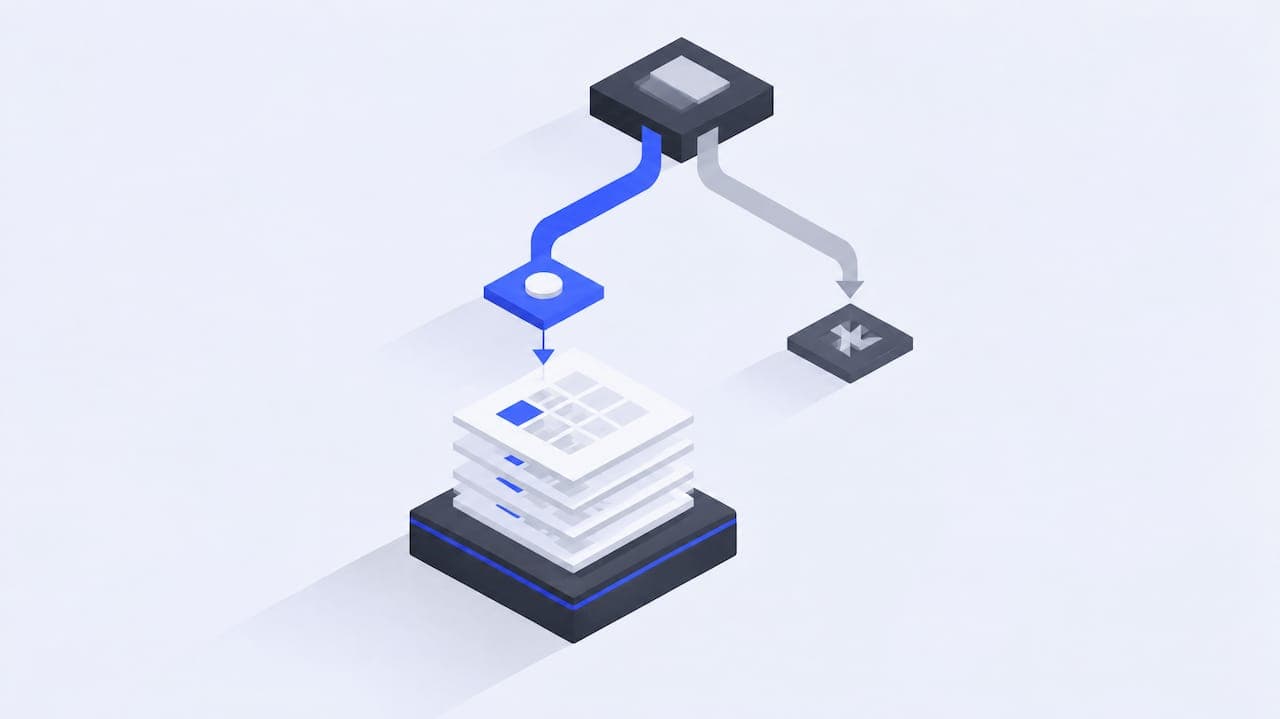
Text-to-SQL turns a plain-language analytics request into executable SQL or an equivalent semantic-model query. It is production-ready for business intelligence only when paired with a maintained semantic layer, clarification controls for ambiguous asks, and execution gates that catch mistakes before they reach a dashboard. Skip any of those three and accuracy numbers from a demo will not survive contact with a real schema.
TL;DR:
- Achieving production-ready accuracy requires a maintained semantic layer, clarification controls, and execution gates to prevent mistakes during text-to-SQL deployment.
- Benchmark success rates are misleading; real enterprise schemas often result in only around 21% task success, making validation on your own data essential.
- Incorporating ambiguity detection and iterative clarification can improve exact-match accuracy by about 50%, reducing the risk of incorrect but plausible results.
- Proper evaluation involves measuring business-truth and false-success rates on your schema with real queries, not just relying on public benchmark scores.
- Automated tools like Vetros can build and maintain semantic models without a data engineering team, easing deployment on small or resource-limited organizations.
Table of Contents
- What text-to-SQL is and how the pipeline works in BI systems
- Where text-to-SQL pays off in business intelligence
- The architecture a reliable pipeline actually needs
- Where text-to-SQL breaks down in production
- How to evaluate a text-to-SQL system before you trust it
- Rolling out text-to-SQL without breaking trust on day one
- How Vetros fits the semantic prep and governance model
- What actually separates a reliable rollout from a risky one
- Start a pilot with Vetros
- Sources
- FAQ
What text-to-SQL is and how the pipeline works in BI systems
Text-to-SQL is the process of converting a natural-language question into a query a database or semantic model can run. In a working BI pipeline, that conversion happens in stages rather than a single leap from words to SQL. The request first goes through intent interpretation, then the system retrieves relevant schema and metadata, maps business terms to actual tables and columns, generates the SQL or DAX, validates it, executes it, and returns results. Microsoft's semantic model guidance describes this as distinct stages of question parsing, semantic-store enrichment, generation, authorization, and execution rather than one undifferentiated step.
Three variants of generation are common in current tools:
- Direct LLM generation, where a model writes SQL straight from the question and a schema description, with no intermediate business layer.
- Semantic intermediate representation, where the question maps first to metrics, dimensions, and filters defined in a semantic model before SQL is produced.
- DAX or native query generation, used inside platforms like Power BI, where the target language is the platform's own query syntax instead of raw SQL.
The project code, dialect documentation, and metadata that support this pipeline typically live outside the model itself: in a metadata store, a semantic model layer, or an indexed schema catalog that the system queries before it writes anything. Oracle's natural language query documentation recommends configuring an explicit AI profile and selecting the relevant tables before generation, rather than pointing a model at an entire database and hoping it picks correctly.
Where text-to-SQL pays off in business intelligence
The clearest wins show up where the gap between a business question and a finished chart used to require a person who knew SQL. Self-service analytics is the obvious case: a marketing manager or support lead can ask for "signups by region last quarter" without waiting in an analyst's queue. Analysts themselves benefit differently, spending less time on repetitive query writing and more on the judgment calls that actually need a trained eye, like deciding whether a metric definition is even the right one to answer the question asked.
- Faster dashboard creation, since a described request can scaffold a chart instead of starting from a blank query editor.
- Natural-language drilldowns, letting a user follow up on a dashboard number without filing a new ticket.
- Reduced queue time for one-off questions that do not justify a full analyst request.
- Lower barrier to entry for teams without a dedicated SQL-literate hire.
AmbiSQL's evaluation found that integrating ambiguity detection and iterative clarification improved exact-match SQL generation accuracy by about 50% compared with generation alone. That figure matters because the biggest BI gains do not come from generating more SQL faster. They come from generating SQL that answers the actual question, which depends heavily on catching ambiguity before the query runs rather than after someone acts on a wrong number.
The architecture a reliable pipeline actually needs
Production reliability depends less on the language model and more on what surrounds it. A semantic model is the anchor: it should define metrics with their exact calculation logic, synonyms for business terms, the grain of each table, and a set of verified answers that map common trigger phrases to canonical queries. Microsoft's guidance on semantic models specifically recommends verified answers as a way to prevent the same question from being interpreted a different way each time it is asked.
For schemas too large to fit in a model's context window, metadata retrieval through indexing or retrieval-augmented search becomes necessary: the system searches a catalog of tables, columns, and business definitions before attempting generation, rather than loading the entire schema every time.
Execution itself needs gating, not trust. That means:
- Sandboxed, read-only execution so a generated query cannot modify data even if it is malformed.
- Row caps and timeouts to stop runaway queries from affecting shared systems.
- Post-execution checks that compare returned results against expected shape or range before they reach a user.
- Business-term mapping through AI data schemas, sometimes called "prep for AI," which pre-labels tables and columns with business-friendly names to cut ambiguity before generation even starts.
Pro Tip: Treat your semantic model as a living document: every time an analyst corrects a bad query, feed that correction back in as a new verified answer or synonym.
Where text-to-SQL breaks down in production

Benchmark scores and production reliability are not the same thing, and the gap is wide. Spider 2.0's evaluation of 632 enterprise workflow tasks found only a 21.3% task success rate, far below what older, simpler benchmarks reported. Enterprise schemas are larger, messier, and full of business logic that a public benchmark table never had to model.
Several failure modes show up repeatedly:
- Ambiguity that produces a confident wrong answer instead of a clarifying question, which is more dangerous than an obvious failure because it looks correct.
- Multi-statement requests that a system silently simplifies, dropping a filter or condition the user actually intended.
- Dialect mismatches, where SQL generated for one database engine fails or behaves differently on another.
- Schema drift, where a table rename or column change breaks previously reliable queries without warning.
- Cost and latency limits that make large-context retrieval impractical for every single question at scale.
The benchmark gap is the single most useful number for setting expectations with stakeholders: a vendor's demo accuracy on a curated dataset tells you almost nothing about how the system will behave on your actual warehouse.
How to evaluate a text-to-SQL system before you trust it
Exact-match accuracy on a public benchmark is close to useless for judging whether a tool will hold up on your data. A better evaluation looks at how the system behaves on your own schema, with your own analysts' real questions, including the ones that should never get a direct SQL answer at all.
- Build a test set from real analyst query logs and your actual production schema, not a public benchmark.
- Measure execution success separately from business-truth rate, since a query can run without error and still answer the wrong question.
- Track false-success rate, meaning queries that return a plausible-looking but incorrect result, since this is the failure mode that causes the most damage.
- Score clarification quality, checking whether the system asks a sensible follow-up when a question is genuinely ambiguous.
- Include multi-round dialogue tests, where a user refines a question across two or three turns, not just single-shot prompts.
- Add abstention cases deliberately, questions with no correct SQL answer, to see whether the system admits it rather than guessing.
- Check permission compliance, confirming that row-level and column-level access rules hold under natural-language phrasing, not just direct SQL.
- Log latency and cost per query at the volume you actually expect, not a handful of test runs.
WarehouseReliabilityBench's findings point in a consistent direction here: deterministic components, rule-gated checks against a semantic layer, static validation, and post-execution verification, reduce false-success rates and raise business-truth rates more reliably than simply using a larger model.
Rolling out text-to-SQL without breaking trust on day one
Adoption succeeds or fails based on preparation, not on the sophistication of the model behind the scenes. A staged rollout gives a BI team room to catch problems before they reach every user in the company.
- Curate the semantic layer first: metric definitions, synonyms for common business terms, table grain, and a starter set of verified answers for the most frequent questions.
- Build ambiguity handling into the interface, not as an afterthought: a clarification prompt should feel like a natural follow-up question, not an error message.
- Separate generation from execution architecturally, so the component that writes SQL never has direct write access, and every query passes through an authorization and post-execution check layer.
- Pilot on one high-value dataset, such as a sales or finance mart that already has clean definitions, rather than opening the whole warehouse at once.
- Collect analyst feedback systematically during the pilot, turning every correction into a new synonym, verified answer, or clarification rule.
- Expand schema coverage gradually, adding new tables only after the semantic model for them has been reviewed, not automatically.
Pro Tip: Run the pilot against a query log you already have instead of inventing test questions. Real questions expose real ambiguity that a hypothetical test set never will.
How Vetros fits the semantic prep and governance model
Teams without a dedicated data engineering org face the same requirements as larger BI teams: a maintained semantic layer, clean metadata, and a system that manages ingestion and modeling reliably. Vetros builds toward that by letting a user describe what they want to see in plain language, then autonomously connecting to data sources and managing ingestion, modeling, and visualization without a manual pipeline to maintain.
- Plain-language requests drive dashboard creation, removing the step where someone has to translate a business question into a query by hand.
- Ingestion, modeling, and refresh are automated, which reduces the ongoing burden of keeping a semantic layer current as source data changes.
- Generated code stays readable and editable, so a team can inspect or adjust what the system built instead of treating it as a black box.
- Data stays within the user's own cloud environment with encrypted storage, addressing the governance concern that comes up whenever a system touches production data directly.
For a small team, the operational weight of maintaining verified answers, synonyms, and refresh logic by hand is often the real barrier to reliable text-to-SQL, more than the quality of any single query generation model.
What actually separates a reliable rollout from a risky one

The industry conversation about text-to-SQL spends too much energy on model benchmarks and not enough on the boring infrastructure that makes a wrong answer rare instead of common. A semantic layer that nobody maintains is worse than no semantic layer at all, because it creates false confidence. The systems that hold up in production are the ones that treat clarification and abstention as features, not failures, and that gate execution the same way any other production system gates a risky write operation.
Before piloting anything, make sure the target dataset already has clean metric definitions and at least a handful of verified answers for the highest-traffic questions. After deployment, watch business-truth rate and clarification rate closely, not just uptime or query volume, since those two numbers tell you whether people are getting correct answers or just fast ones.
— Ąžuolas
Start a pilot with Vetros
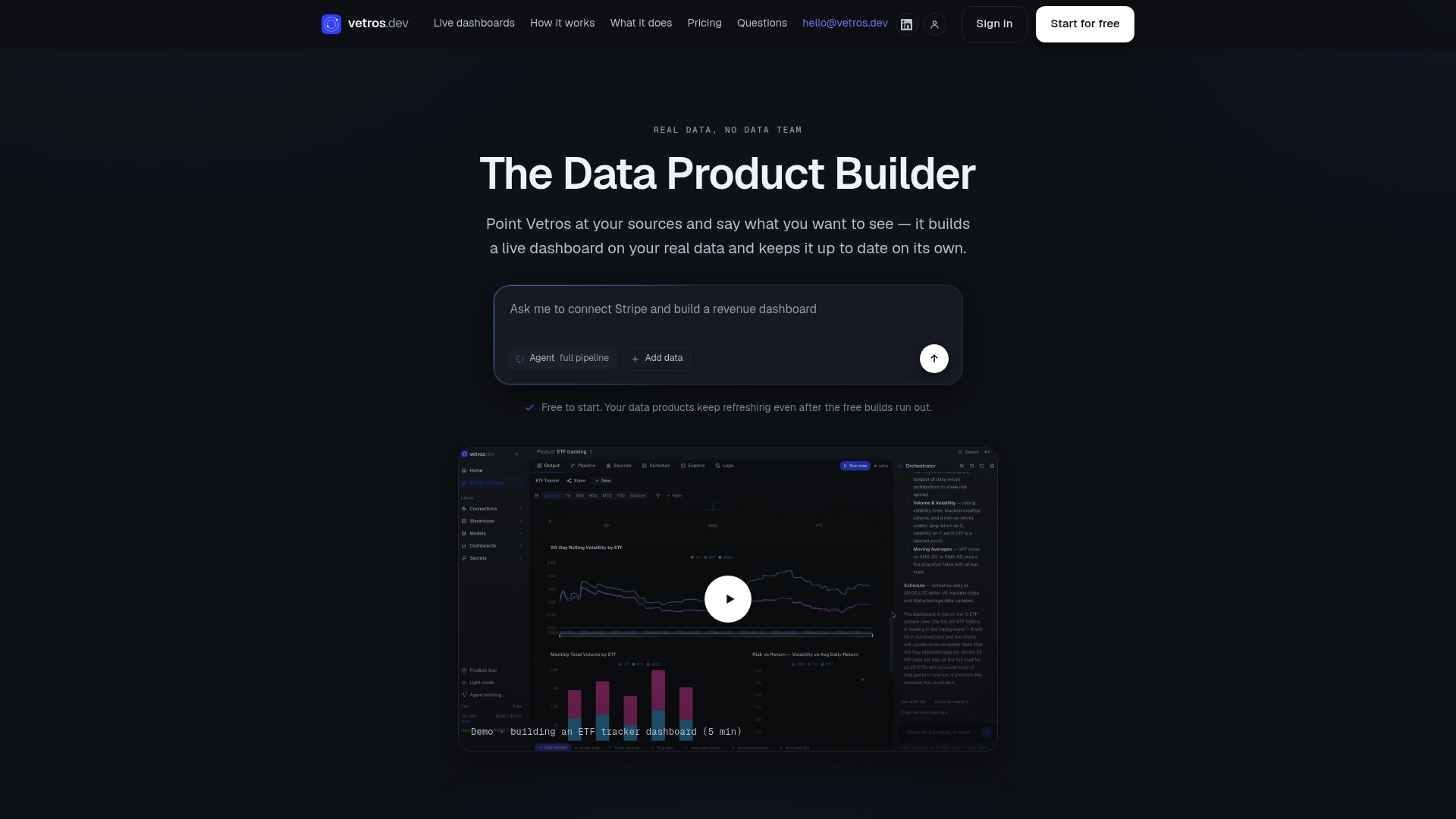
Most teams that need text-to-SQL for BI do not have a data engineer available to build and maintain the semantic layer that makes it reliable. Vetros handles that groundwork automatically: describe the dashboard you want, and it connects to your data sources, builds the models, and keeps everything current without a pipeline for anyone to babysit.
- Start with a free trial build to see how the platform models one of your existing data sources.
- Move to a Pro plan at $99 per month once you are ready to run live dashboards beyond the trial.
- Scale to Team or Enterprise as more people across the business need access to the same live data.
Visit Vetros to connect a data source and see a dashboard built from a plain-language description.
Sources
Microsoft's semantic model best practices documents how verified answers and business-friendly naming reduce ambiguity in generated queries. Spider 2.0 shows the real gap between benchmark and enterprise performance across 632 workflow tasks. AmbiSQL demonstrates how ambiguity detection changes accuracy outcomes. WarehouseReliabilityBench ties deterministic, rule-gated architecture to lower false-success rates. For governance patterns relevant to conversational BI deployments, see webAI's sovereign deployment work and Atherya's notes on model governance.
- Microsoft: semantic model best practices (Fabric)
- AmbiSQL: Interactive Ambiguity Detection and Resolution for Text-to-SQL
FAQ
What is text-to-SQL in the context of business intelligence?
Text-to-SQL is the conversion of a plain-language question into a SQL query or equivalent semantic-model query that a BI system can execute. In practice it involves interpreting intent, retrieving relevant schema metadata, mapping business terms, generating the query, validating it, and returning results.
How accurate is text-to-SQL on real enterprise data?
Accuracy on enterprise schemas is much lower than public benchmark numbers suggest. Spider 2.0 found only a 21.3% task success rate on 632 real enterprise workflow problems, far below older benchmark results, which shows why a semantic layer and validation gates matter more than raw model choice.
Why does ambiguity matter so much in text-to-SQL systems?
An ambiguous question that gets a confident wrong answer is more damaging than one that fails outright, because a plausible-looking result can go unchecked into a decision. AmbiSQL's research found that adding ambiguity detection and clarification improved exact-match accuracy by about 50%, which is why clarification behavior should be tested explicitly rather than assumed.
What should a BI team evaluate before adopting a text-to-SQL tool?
Look past exact-match accuracy and test execution success, business-truth rate, false-success rate, clarification quality, and permission compliance on your own schema and real analyst questions. Tools that separate query generation from execution and run post-execution checks tend to show lower false-success rates in production-like testing, according to WarehouseReliabilityBench.
Does Vetros require a data team to set up text-to-SQL style dashboards?
No. Vetros connects to data sources and automatically manages ingestion, modeling, and dashboard creation from a plain-language description, without requiring a dedicated data engineering team to maintain the pipeline.