

A single source of truth is the one authoritative record for a given piece of data, reconciled from every system that touches it, so finance, sales, and product teams work from the same numbers. You need one when different departments report conflicting revenue, churn, or inventory figures. Done right, an SSOT means faster decisions, cleaner dashboards, and fewer meetings that start with "whose number is right?"
TL;DR:
- A single source of truth consolidates data from multiple systems of record to provide an authoritative, organization-wide view, reducing conflicting reports.
- Architecture options include master data management for reference data, data warehouses for reporting, event stores for full history, and federation for live querying without duplication.
- Implementing an SSOT requires defining scope, designing data models, establishing identity resolution, and gradually rolling out with continuous monitoring.
- Strong governance involving ownership, lineage tracking, and automated data integrity checks is crucial for maintaining trustworthiness and preventing failures.
- Platforms like Vetros automate data ingestion and dashboard creation, enabling quick deployment for small teams without extensive data engineering resources.
Table of Contents
- Single Source of Truth vs. System of Record vs. Single Version of Truth
- The Business Case: Why Reconciliation Pays for Itself
- SSOT Architectures: MDM, Warehouses, Event Stores, and Federation
- How to Build a Single Source of Truth: A Step-by-Step Checklist
- Governance and Integrity Controls That Make an SSOT Defensible
- Where SSOT Projects Go Wrong
- Vetros: Trusted Dashboards Without a Full Data Team
- What Actually Determines Whether Your SSOT Survives
- Getting Started With Vetros
- Sources
- FAQ
Single Source of Truth vs. System of Record vs. Single Version of Truth
These three terms get used interchangeably, and that's where most confusion starts. A system of record (SOR) is the operational application that owns a specific data element. Your CRM is the SOR for lead status. Your ERP is the SOR for purchase orders.
A single source of truth (SSOT) sits above that. It's the reconciliation layer that pulls from multiple SORs and produces one authoritative version of a data element for the whole organization. According to IBM, a single SOR usually can't function as an enterprise SSOT because it only sees its own slice of the business, not the full picture.
A single version of truth (SVOT) is closely related but usually refers specifically to consistent reporting metrics across the company, like everyone agreeing on the definition of "active customer."
- SOR = the operational owner of raw data
- SSOT = the reconciled, cross-domain authoritative record
- SVOT = agreement on metric definitions for reporting
Customer 360 is the clearest example: marketing, sales, and support each hold a partial customer record, and the SSOT stitches those into one profile.
The Business Case: Why Reconciliation Pays for Itself
Every hour analysts spend reconciling conflicting spreadsheets is an hour not spent on analysis. That's the real cost center most companies underestimate.
An SSOT cuts that waste in a few concrete ways:
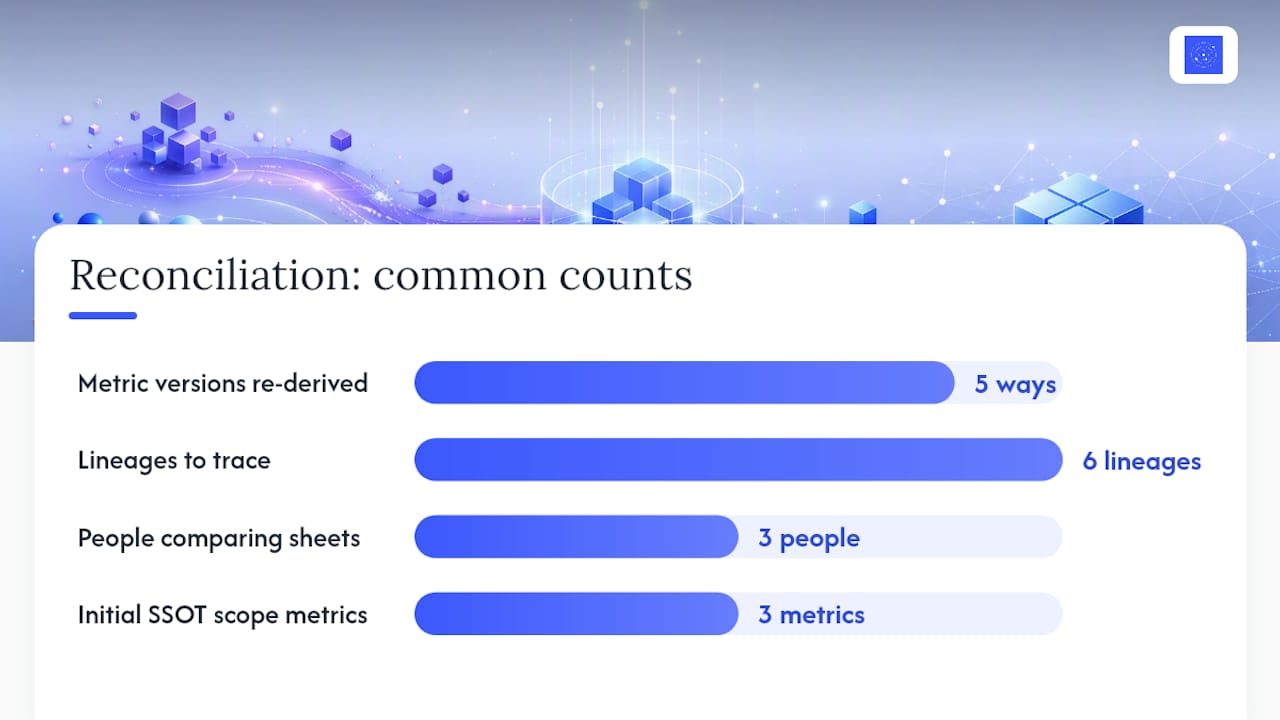
- Teams stop re-deriving the same metric five different ways in five different tools.
- Executives get dashboards they can act on immediately instead of interrogating first.
- Audit and compliance reviews move faster because there's one lineage to trace, not six.
- Machine learning models trained on reconciled data produce more reliable predictions, since garbage-in still means garbage-out for AI.
Pro Tip: Before building anything, ask your leadership team to name the three metrics that cause the most cross-department disagreement. Those three become your SSOT's first scope, not the whole data warehouse.
Centralizing authoritative data around use cases like Customer 360 profiles reduces duplication and speeds up decisions that used to require three people comparing spreadsheets before a meeting could even start.
SSOT Architectures: MDM, Warehouses, Event Stores, and Federation
There's no single blueprint for an SSOT. The right architecture depends on how fast your data changes and who needs write access.
Master data management (MDM) works as a hub-and-spoke reconciliation layer. Source systems feed into the hub, which applies matching rules and publishes a golden record back out. It's strong for reference data like customer or product master data that doesn't change every second.
Data warehouses (or lakehouses) often serve as the practical single version of truth for reporting. They're not always a true real-time SSOT, since batch loads introduce lag, but for most BI use cases, a well-modeled warehouse is close enough and far simpler to run than a full MDM program.
Event stores capture every change as an immutable event, which makes them the canonical source for systems that need full history, like financial transactions or audit trails. Red Hat's architecture guidance notes that event sourcing trades simplicity for auditability, since replaying events to rebuild state adds complexity most reporting use cases don't need.
Virtual integration (federation) skips centralizing data at all. Queries hit source systems live through a semantic layer. It avoids duplication and latency from copying data, but it puts real strain on source systems and makes governance harder to enforce consistently.
- MDM: strong for reference data, slower to change
- Warehouse/lakehouse: fast reporting SSOT, some batch lag
- Event store: full history and auditability, higher complexity
- Federation: no duplication, weaker governance control
Pick based on latency needs first, then governance capacity. Most mid-size companies land on a warehouse-first approach and add MDM only for the domains that need strict identity resolution.
How to Build a Single Source of Truth: A Step-by-Step Checklist
Skipping steps here is how SSOT projects turn into two-year data-warehouse rebuilds nobody uses. Work through this in order.
- Define scope and priority KPIs. Pick one domain (customer, revenue, or inventory) and the three to five metrics that matter most. Resist the urge to model everything at once.
- Design a unified data model and naming conventions. Agree on what "active customer" or "closed deal" means before you write a single pipeline.
- Implement identity resolution and golden record rules. Decide how records from different systems get matched and which source wins when they conflict.
- Choose your ingestion pattern. Change data capture (CDC) works for near-real-time needs, APIs for on-demand pulls, and batch for anything that doesn't need to be fresh by the minute. Build the field mapping alongside this decision, not after.
- Define reconciliation and conflict-resolution policies. Set SLAs for how fast conflicts get flagged and resolved, and document who owns the final call.
- Test, monitor, and roll out incrementally. Launch with one team, watch for drift, then expand domain by domain.
Pro Tip: Treat step 3, identity resolution, as the make-or-break step. Most SSOT failures trace back to sloppy matching rules that silently merge or split records that shouldn't have been touched.
Governance and Integrity Controls That Make an SSOT Defensible
An SSOT without governance is just a bigger place to be wrong. Ownership has to be explicit: every data domain needs a named steward responsible for schema changes, and every schema change needs a version history so downstream teams aren't surprised by a silently renamed column.
Lineage and traceability matter just as much. You need to know where a number came from and every transformation it passed through, not just its final resting place in a dashboard. That traceability is also what makes audits fast instead of painful.
- Assign domain owners and require change-control approval for schema edits.
- Capture lineage from source system to final metric, including transformation logic.
- Run automated data-integrity checks, not manual spot audits.
- Enforce access controls and maintain audit logs for who touched what, and when.
NIST defines data integrity as data that hasn't been altered in an unauthorized way across storage, processing, and transit, and that standard applies at every stage of your pipeline, not just at rest. Cloud platforms increasingly bake this in: AWS's data-integrity tooling can automate quality rules and monitoring so integrity checks run continuously instead of once a quarter.
Where SSOT Projects Go Wrong
Most SSOT failures aren't technical. They're scope and maintenance failures that show up months after launch.
- Overcentralization. Trying to model the entire enterprise before proving value on one domain burns budget and patience before anyone sees a benefit.
- Ontological collisions. Two departments calling different things "revenue" (booked vs. recognized) creates silent inconsistencies unless a canonical data dictionary settles the definition upfront.
- Stale masters. A golden record that stops refreshing becomes worse than no SSOT at all, because people trust it by default. Monitoring and refresh SLAs catch this before it erodes trust.
- Vendor lock-in. Building your entire reconciliation layer inside one proprietary platform can make future migration painful. Favor open standards and exportable schemas where you can.
Vetros: Trusted Dashboards Without a Full Data Team
Not every company can staff an MDM program or a data engineering team to maintain pipelines. Some data platforms automate the ingestion, modeling, and dashboard layer that usually eats months of engineering time. Describe what you want to see, and Vetros connects to your sources, builds the model, and keeps dashboards live.
It doesn't replace the governance decisions above. You still own the definitions, the identity-resolution rules, and who's accountable for the numbers. Such platforms handle the plumbing and keep the code transparent and traceable, so what they automate is visible, not a black box.
What Actually Determines Whether Your SSOT Survives
Start with one domain that has a measurable business impact, like revenue recognition or customer churn, and pick KPIs you can defend in a leadership meeting within weeks, not quarters. Perfect modeling upfront is a trap. Ship something narrow, watch how people actually use it, and adjust.
The tension nobody talks about enough is governance versus discoverability. Lock the SSOT down too hard and teams route around it with their own spreadsheets, which defeats the entire point. Leave it too open and you lose the integrity controls that made it trustworthy in the first place. The best SSOT implementations treat that balance as an ongoing decision, not a one-time design choice.
— Ąžuolas
Getting Started With Vetros
If you're evaluating whether to build an SSOT-backed reporting layer yourself or hand the plumbing to a platform, check four things: how many source connectors it supports out of the box, whether you can see the lineage behind every number, what refresh SLA it guarantees, and whether it plugs into your existing access controls instead of creating a separate silo.
For small teams, analysts, and startups without a dedicated data engineer, building that stack from scratch usually means months of setup before the first dashboard even loads. Vetros skips that by connecting directly to your sources and building live, traceable dashboards from a plain-language request, with encrypted storage and code you can read and edit yourself. If your team is stuck reconciling numbers by hand every week, start a trial and see how fast a working dashboard actually appears.
Sources
- System of Record vs. Source of Truth: What's the Difference? | IBM
- Data integrity | NIST
- What is Data Integrity? - AWS
- Single source of truth architecture | Red Hat blog
- What Is a Single Source of Truth (SSoT)? Definition & Examples | Techopedia
For governance frameworks specifically, Molded Fortitude Consulting covers the kind of disciplined change management that SSOT rollouts often need beyond the technical build.
FAQ
What is a single source of truth?
A single source of truth is the one authoritative, reconciled record for a piece of data, pulled together from every system that touches it, so every team works from the same figure instead of conflicting reports.
What is another word for a single source of truth?
The closest related term is "single version of truth," which usually refers to consistent metric definitions used in reporting rather than the full reconciled data record itself.
What is an example of a single source of truth?
Customer 360 is the most common example: a reconciled profile that combines data from marketing, sales, and support systems into a single authoritative customer record.
How is an SSOT different from a system of record?
A system of record owns one specific type of data, like a CRM owning lead status, while an SSOT reconciles data from multiple systems of record into one authoritative, cross-domain view.
Do I need a full data team to build an SSOT?
Not necessarily. Platforms like Vetros automate ingestion and dashboard modeling, though you still need to define ownership, identity-resolution rules, and governance policies yourself.