
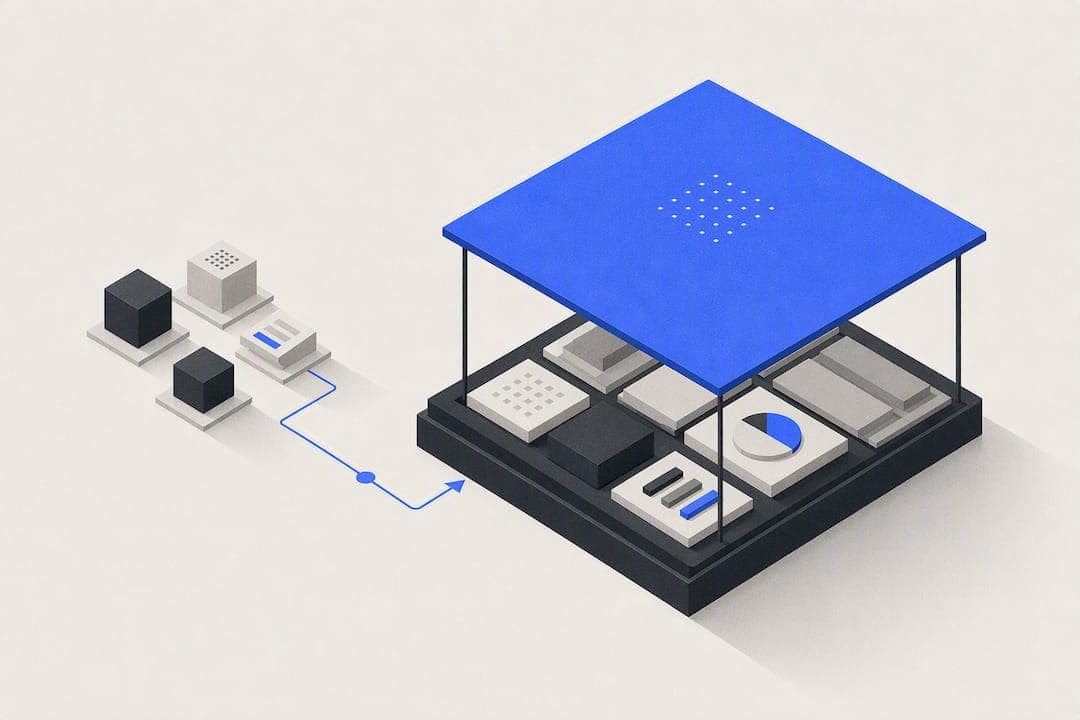
Secure dashboards are autonomous, live business intelligence tools that connect to your data, refresh automatically, and stay protected with encryption, access controls, and traceable code, all without needing a dedicated data team. The bottom line is that small businesses and startups can get this today by choosing a platform that handles ingestion, modeling, and governance on its own. What you should demand from any vendor is straightforward: encrypted storage, role-based access, audit logs, and editable, transparent code that shows exactly how your numbers were built.
TL;DR:
- Small businesses can implement secure dashboards quickly using platforms that automate data ingestion, modeling, and governance, reducing manual effort and errors.
- Ensuring data security requires encryption at rest, role-based access controls, full audit logs, and transparent, editable code to verify data lineage and prevent trust issues.
- Optimal refresh rates depend on metric usage; most dashboards benefit from predictable, stable load times, with hourly or daily updates often sufficient for decision-making.
- Choosing the right encryption model involves understanding CMEK for control over keys without operational burden, versus BYOK for full ownership of raw encryption keys.
- Starting small with a pilot connecting 3-5 KPIs allows rapid deployment and assessment without a dedicated data team, before scaling based on trust and cost-effectiveness.
Table of Contents
- What Makes a Dashboard Actually Secure?
- Why Do Weak Data Practices Undermine Trust?
- What Should You Require From a Secure Dashboard Platform?
- How Fast Should Your Dashboard Really Refresh?
- What Encryption Details Actually Matter?
- How Do You Roll This Out Without a Data Team?
- Why Automation Plus Governance Is the Pragmatic Choice
- Getting Started With Vetros
- Sources
- FAQ
What Makes a Dashboard Actually Secure?
A secure dashboard isn't just a chart with a password on it. It's a full pipeline, and each piece matters. Connectors pull data from wherever it lives, your CRM, your payment processor, a spreadsheet someone still updates by hand, and feed it into an ingestion layer that cleans and structures it without a human babysitting the process.

That's the difference between "automated" and the old way of doing things. Traditional business intelligence setups relied on analysts hand-writing SQL and manually rebuilding models every time a source changed. Automated ingestion and modeling do that work continuously, which removes both the labor cost and the human error that comes with rushed manual edits.
The security part shows up in what happens next: how the data is stored, who can see it, and whether you can verify any of it yourself. A platform like Vetros generates the underlying code for your dashboards and lets you read and modify it directly, which means nothing is a black box. That transparency, combined with clear data lineage, tells you exactly where a number came from and who touched it along the way.
Why Do Weak Data Practices Undermine Trust?
Most dashboard failures aren't hacking incidents. They're trust failures, and they start long before any bad actor gets involved. When a team can't agree on which number is correct, or nobody can explain how a metric was calculated, people quietly stop trusting the dashboard and go back to gut instinct or dueling spreadsheets.
Research backs this up directly. Data quality and data integration rank as the top priorities for organizations trying to improve decision-making, according to LeBow/Drexel's State of Data Integrity and AI Readiness report, with governance and privacy close behind. Organizations running active governance programs report meaningfully higher trust in their own data than those without one.
That gap has real consequences for a small business. Bad decisions get made on stale or wrong numbers. Compliance exposure grows quietly, especially once customer or financial data flows into dashboards nobody is monitoring for access anomalies. And once trust erodes, it's expensive to rebuild, because people revert to checking everything manually, which defeats the entire purpose of automation.
Governance and observability fix this by making the pipeline visible. If you can see when a metric last refreshed, who has access, and whether a schema changed unexpectedly, you catch problems before they become disputes in a Monday morning meeting.

What Should You Require From a Secure Dashboard Platform?
Before you sign up for anything, get concrete answers on these points. Vague reassurances ("we take security seriously") aren't good enough for data that touches customers, revenue, or compliance.
- Encryption and key management: ask whether the platform offers customer-managed encryption keys (CMEK) or lets you bring your own key (BYOK), and how key rotation is handled.
- Access controls: confirm role-based permissions, single sign-on support, and whether every access event gets logged for audit purposes.
- Lineage and editability: you should be able to see, and ideally modify, the generated code behind every dashboard, plus track where each data point originated.
- Connector coverage: check that the platform natively supports your actual sources, whether that's a SaaS app, a SQL database, or flat files, without requiring custom engineering.
- Freshness and cost controls: ask what refresh cadences are available and whether you can dial frequency up or down to control compute cost.
Pro Tip: Ask a prospective vendor to show you a live audit log during the sales call, not just describe one. If they can't pull it up on the spot, that tells you something about how mature the feature actually is.
Red flags include vague answers about where data is stored, no mention of encryption at rest, or a "trust us" response when you ask about key management. A vendor following CMEK best practices should be able to explain key separation and rotation without hesitation.
How Fast Should Your Dashboard Really Refresh?
Every team wants real-time everything until they see the bill. The truth is that most business metrics don't need sub-second freshness, they need predictable, reliable freshness you can trust every time you load the page.
Research on large-scale dashboard architecture backs this up. The Napa system uses precomputed materialized views specifically because stable, low-variance query performance tends to matter more to users than shaving milliseconds off an already-fast query. A dashboard that loads consistently in two seconds beats one that's usually instant but occasionally hangs for thirty.
For a small team, this translates into a practical decision: pick your refresh cadence based on how the metric gets used, not on what sounds impressive. Sales pipeline numbers might warrant hourly refreshes. A monthly financial summary doesn't need to update more than once a day. Streaming ingestion makes sense for operational alerts; micro-batch or scheduled refresh works fine, and costs far less, for most reporting dashboards. Materialized views and caching layers let a platform serve fast, stable results without recomputing everything on every page load.
What Encryption Details Actually Matter?
Encryption at rest means your data is scrambled into unreadable ciphertext while it's sitting in storage, so even if someone got physical or unauthorized access to the disk, they couldn't read anything without the key. Google Cloud's default encryption at rest architecture uses layered key wrapping as its baseline standard, which is a reasonable floor for any vendor to meet.
Beyond that floor, the choice of key management model matters more than most non-technical buyers realize:
- Cloud-managed keys are the simplest option: the provider handles everything, which is fine for lower-sensitivity data.
- Customer-managed encryption keys (CMEK) give you control over key creation, rotation, and revocation while the provider still does the heavy lifting.
- Customer-supplied keys (CSEK), sometimes marketed as BYOK, put you in charge of the raw key material itself, which Google Cloud's documentation notes requires careful operational handling.
Operationally, verify that rotation happens on a schedule, that access follows least-privilege principles, and that every key action gets logged. On the low-effort side, ask whether the platform supports masking sensitive fields and minimizing what data gets ingested in the first place. Less exposed data means less to secure.
How Do You Roll This Out Without a Data Team?
You don't need a six-month project plan. A small team can move through this in weeks if the platform is genuinely automated.
- Pick 3 to 5 KPIs and their source systems. Resist the urge to connect everything at once; start with what actually drives decisions.
- Run a time-boxed pilot. Connect those sources, build one dashboard, and set a refresh cadence that matches how often the numbers actually change.
- Turn on access controls and lineage during the pilot itself, not after. This is when you catch permission mistakes before they become habits.
- Evaluate cost, trust, and effort before scaling. If the pilot dashboard gets checked daily and nobody's second-guessing the numbers, you've found your model.
Why Automation Plus Governance Is the Pragmatic Choice
Automation removes the staffing bottleneck that used to make secure dashboards a luxury only bigger companies could afford. But automation without governance just moves the risk instead of solving it. The teams that get the best results treat both as one package: fewer arguments over whose numbers are right, faster decisions, and less time spent reconciling spreadsheets.
Heavier data infrastructure, dedicated engineers, custom pipelines, still makes sense once you're managing dozens of sources or need bespoke modeling. Most small teams never reach that point.
Getting Started With Vetros
Vetros was built around the exact checklist this article just walked through. You describe what you want to see in plain language, and it handles connecting to your sources, modeling the data, and building the dashboard, no manual pipeline maintenance required. Generated code stays fully readable and editable, data lineage stays traceable, and everything is stored encrypted within your own cloud environment rather than shipped off to a black box.
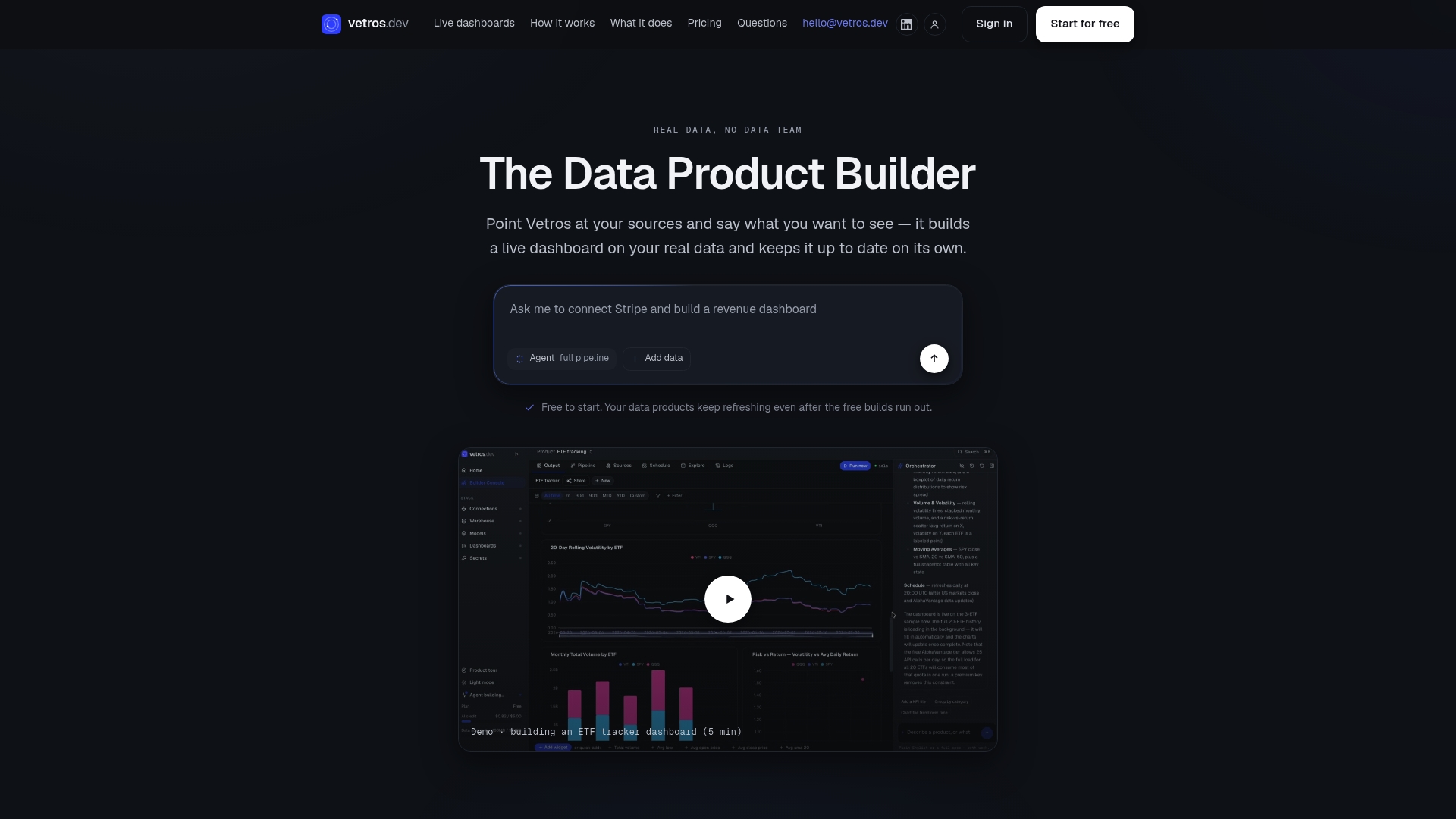
Getting started doesn't require a procurement process. The Free plan lets you run a limited pilot before committing to anything, which is exactly the time-boxed approach the rollout plan above describes: pick a few KPIs, connect your sources, and see whether the dashboard earns daily trust. If it scales past that, the Pro plan starts at $99 per month and Team plans start at $349 per month for larger workspaces. Founders and non-technical operators tend to benefit most, since there's no data hire required to see results. Start with the free tier, run your pilot, and decide from there whether to scale up.
Sources
- 2026 State of Data Integrity and AI Readiness (LeBow/Drexel)
- Napa: Powering scalable data warehousing with robust query performance
FAQ
What Are Secure Dashboards, Exactly?
Secure dashboards are live business intelligence tools that connect to your data sources, refresh automatically, and protect information through encryption, access controls, and audit logging. Unlike traditional BI setups, platforms like Vetros also expose editable generated code and data lineage, so nothing about how a number was built stays hidden.
Do I Need a Data Team to Get One?
No. Automated ingestion, modeling, and governance workflows are specifically designed to remove that requirement, which is why adoption of automation and cloud tools has grown among organizations with limited in-house data skills, per LeBow/Drexel's 2023 findings. A non-technical founder can run a pilot dashboard in weeks, not months.
How Often Should My Dashboard Refresh?
It depends on how the metric gets used, not on what sounds most impressive. Research on production dashboard systems, including the Napa architecture, shows that stable, predictable load times often matter more to users than raw sub-second freshness.
What's the Difference Between CMEK and BYOK?
Customer-managed encryption keys (CMEK) let you control key creation and rotation while the cloud provider still manages key infrastructure, following practices outlined in Google Cloud's CMEK guidance. Bring-your-own-key (BYOK), often implemented as customer-supplied keys, puts you in charge of the raw key material itself, which carries more operational responsibility.
How Much Does Vetros Cost?
Vetros offers a Free plan to start, with tiered paid plans available depending on source count, refresh frequency, and seats. Enterprise pricing is available on request directly through Vetros.