

A metrics dictionary is a governed, centralized reference that defines every business metric once, in plain language and in exact calculation logic, so every team pulls the same number for the same term. The core payoff is consistency: analysts stop reconciling conflicting dashboards and leaders make faster calls because the figures are auditable. Getting there requires clear ownership and an approval process, not just a spreadsheet of names.
TL;DR:
- A metrics dictionary ensures consistency in business measurements by defining each metric with clear business and technical descriptions, ownership, and lifecycle stages.
- Maintaining a governed dictionary involves assigning owners, validating definitions through approval processes, and tracking changes with version control to prevent drift.
- Storing definitions in schema-validated YAML or JSON files enables automated checks, faster updates, and integration with dashboards, reducing manual errors.
- Regular monitoring of metadata availability, schema coverage, and freshness latency helps keep the dictionary reliable and current across source systems.
- Use versioning and deprecation practices for metrics to avoid silent errors, and combine automation with human oversight to ensure meaningful and trustworthy metrics.
Table of Contents
- What goes into a metric entry
- A reusable template you can fill in today
- Building the dictionary: a step-by-step lifecycle
- Governance keeps metrics from drifting apart
- Formats and integrations that make it machine-readable
- Tracking the health of the dictionary itself
- Keeping the dictionary maintained over time
- Why automation still needs a human owner
- An automated way to keep metrics current
- Sources
- FAQ
What goes into a metric entry
Every metric needs two separate definitions living side by side. The business definition explains what the metric means in plain terms a non-technical stakeholder can grasp. The technical definition specifies exactly how it is computed, ideally with SQL or pseudocode that any engineer can rerun and verify. Microsoft's Metrics Advisor glossary frames metrics as measures that need granularity and alert configuration spelled out, which is exactly the kind of ambiguity a dictionary entry should close.
A complete entry typically includes:
- Metric name and a one-line business definition.
- Canonical calculation, written as SQL or pseudocode.
- Data source, time frame, granularity, and reporting context.
- Owner or steward, current status, and lineage back to source tables.
Keep names short, lowercase, and free of embedded versions or qualifiers. Renaming a metric in place breaks every dashboard referencing it, so version history belongs in a lifecycle field, not the name itself.
A reusable template you can fill in today
Documenting a metric goes faster with a fixed template rather than a blank page each time. Fill in the fields below for every new entry, then leave notes for edge cases such as null handling, cohort windows, or attribution rules, since these are where teams most often disagree later.
| Field | What to enter |
|---|---|
| Name | Short, lowercase, no version numbers |
| Business definition | Plain-language meaning for non-technical readers |
| Calculation | SQL or pseudocode, exact and testable |
| Data source | Table, API, or system of record |
| Owner | Named person or team accountable for accuracy |
| Status | Proposed, approved, or deprecated |
A filled example: monthly active users, defined as "distinct accounts with at least one logged session in a calendar month," calculated as a distinct count of user IDs from the sessions table filtered by event date, sourced from the product event warehouse, owned by the analytics team, and marked approved. Edge case notes would cover how to treat accounts created mid-month and whether internal test accounts are excluded.
Building the dictionary: a step-by-step lifecycle
Rolling out a metrics dictionary works best as a repeatable sequence rather than a one-time document drop.
- Identify stakeholders and the questions each team actually needs answered.
- Map each candidate metric to its source tables and capture the lineage from raw data to output.
- Draft the business and technical definitions, including example SQL or pseudocode.
- Validate the draft with the metric's owner and move it to canonical status through a formal approval step.
- Publish the definition in a machine-readable format and wire it into dashboards and CI pipelines.
- Monitor for drift and schedule recurring reviews so definitions stay current as source systems change.
This mirrors the lifecycle described in Cloud Monitoring's naming guidance, which stresses mapping metrics to sources and documenting lineage before anything gets locked down.
Pro Tip: Centralize naming rules in a shared style guide and enforce them in CI instead of relying on individual analysts to remember them.

Governance keeps metrics from drifting apart
A dictionary only stays trustworthy when someone is accountable for each entry. Every metric needs a named owner or steward whose job includes reviewing changes and confirming the definition still matches reality. According to GitLab's metrics dictionary guide, canonical status should be visible and controlled by that human owner, moving through a lifecycle of proposed, approved, and eventually deprecated or removed.
- Owners review and sign off on any change before it becomes canonical.
- Automated checks flag when underlying SQL or source tables change unexpectedly.
- A metric that drifts from its documented calculation reverts to non-canonical until revalidated.
- Deprecated metrics stay visible with a clear status rather than disappearing silently.
Automation catches the drift; a person still decides whether the new number is correct.
Formats and integrations that make it machine-readable
A dictionary that lives only in a document gets stale fast. Storing definitions in YAML or JSON with schema validation keeps every entry structurally consistent and lets CI reject a malformed or incomplete metric before it ships. JSON Schema's type system is a practical fit here, since it enforces required fields and correct types on every definition file.
- Store each metric as a YAML or JSON object validated against a shared schema in CI.
- Rebuild the dictionary on a schedule, hourly for fast-moving pipelines, so it reflects the latest source changes.
- Connect definitions to metadata catalogs, dashboard tools, and contract tests that compare live queries against the documented calculation.
GitLab's approach also recommends contract tests that fail a build when a dashboard query no longer matches its documented formula, which catches silent drift before it reaches a report.
Tracking the health of the dictionary itself
A dictionary is a product, and like any product it needs its own reliability targets. The DataOps School guide to data dictionaries suggests a compact set of service-level indicators for exactly this purpose.
| SLI | How to calculate it | Starting target |
|---|---|---|
| Metadata availability | Uptime of the dictionary service or catalog | 99.9% |
| Schema coverage | Share of metrics with a complete, validated schema | 80% |
| Freshness latency | Time between source change and dictionary update | under 5 minutes for streaming data |
| Ownership coverage | Share of metrics with a named, active owner | 95% |
The common pitfall is using the wrong denominator, counting only actively used metrics rather than every entry ever published, which inflates coverage numbers and hides stale definitions.
Keeping the dictionary maintained over time
A short recurring checklist prevents most of the problems that make dictionaries rot.
- Never rename a metric in place; add a new version and deprecate the old one with a status field.
- Require an owner and a reporting context on every entry before it can be marked approved.
- Add CI checks and contract tests that compare documented calculations against live queries.
- Retire metrics deliberately: mark them deprecated, keep the definition visible, then remove after a set window.
Pro Tip: Run a quarterly audit of deprecated metrics still referenced in active dashboards, since these are the most common source of silent reporting errors.
Why automation still needs a human owner
Automated pipelines can keep a dictionary fresh, but they cannot replace judgment about what a number should mean. The most useful automation handles freshness, ingestion, and CI validation, the repetitive work that used to eat an analyst's week. Editable, readable generated code matters here: if you cannot see how a definition was built, you cannot trust it or fix it when it drifts.
— Ąžuolas
An automated way to keep metrics current
The platform builds and maintains live dashboards from plain-language requests, connecting to data sources and handling ingestion, modeling, and visualization without requiring a dedicated data team.
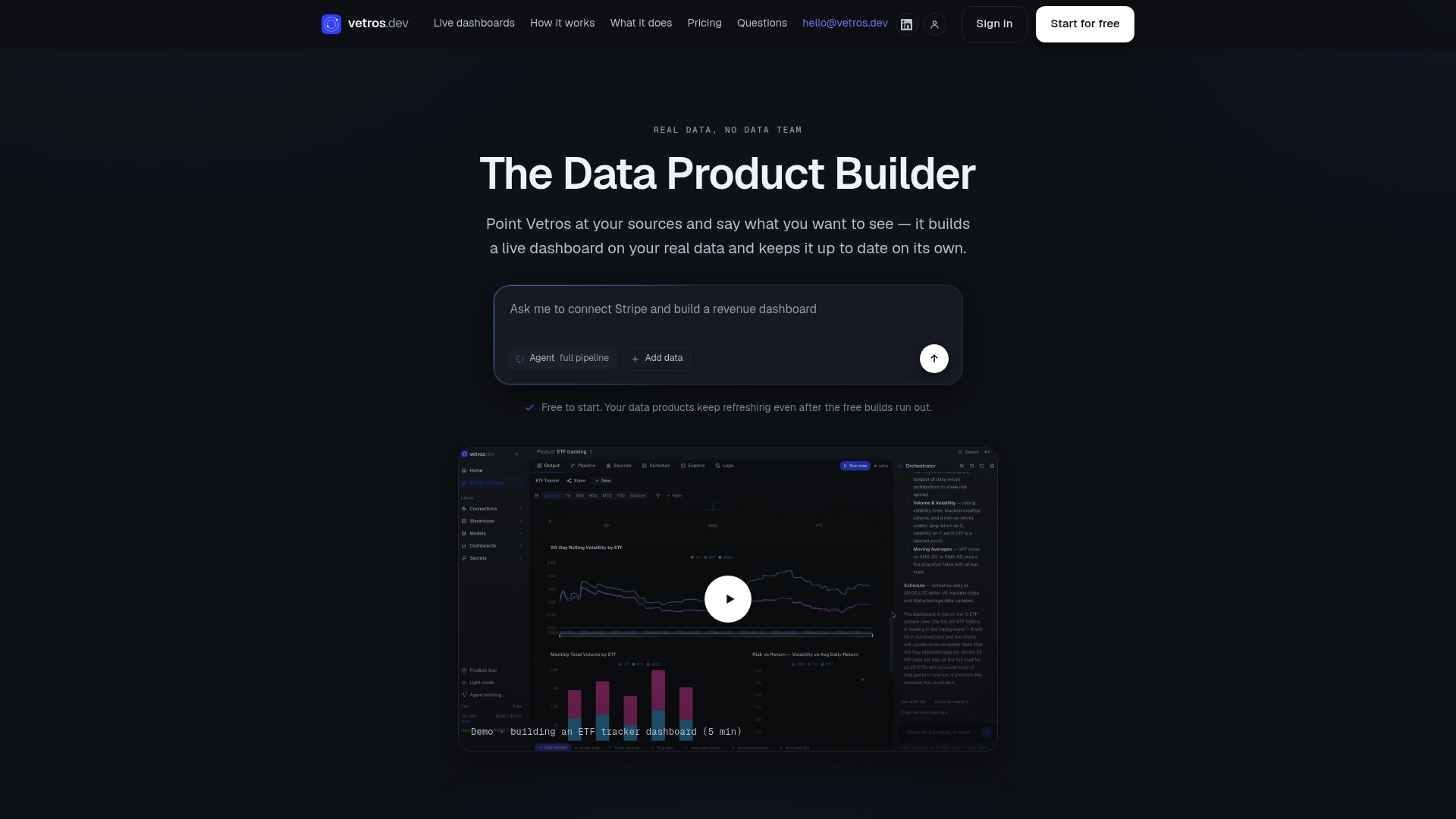
That autonomy takes a real chunk of the maintenance burden off your dictionary, since refreshes and lineage tracking happen automatically rather than through manual pipeline work, and the generated code stays editable so you can verify exactly how each number is built. Check current plans and pricing at Vetros.
Sources
For deeper detail, see GitLab's metrics dictionary guide, Microsoft's Metrics Advisor glossary, and domain examples like Voclify's YouTube analytics glossary.
- Metrics Dictionary Guide | GitLab Docs
- Metrics Advisor glossary - Azure AI services | Microsoft Learn
- Understanding JSON Schema — types
FAQ
What's another word for metrics?
Common alternatives include "KPIs," "measures," or "performance indicators," though each carries a slightly different scope. A metric is typically the raw quantifiable value, while a KPI is a metric tied to a specific business goal.
Which is correct, metrics or metrices?
"Metrics" is the correct plural form in standard English usage. "Metrices" is not an accepted variant and does not appear in technical or business glossaries.
What is a metric vs measure?
A measure is typically a single raw number, like total revenue, while a metric often combines measures into a calculated ratio or rate, like revenue per customer. In practice, many teams use the terms interchangeably, but a dictionary should specify which one each entry actually is.
What is an example of metrics?
Monthly active users, customer churn rate, and average order value are common business metrics, each requiring its own documented calculation. Engineering teams also track metrics like deployment frequency, drawing on frameworks cataloged in glossaries such as DevStats.
Do all metrics need an owner?
Yes, every metric in a governed dictionary should have a named owner accountable for its accuracy and updates. Without an owner, metrics tend to drift from their documented calculation without anyone noticing until the numbers stop matching.